
A claim is only the beginning.
What a product says it can do must be tested against what it actually delivers.
Exactly As Stated. is not just a tagline. It is an operating rule.
Specifications are easy to print.
Harder to prove.
Capacity. Power. Charging speed. Compatibility. Protection. Durability. Any of these can appear on a product page or a box.
At CITADEL, a printed specification is not automatically treated as verified performance.
A claim becomes meaningful when the product, the test conditions and the result can be connected.
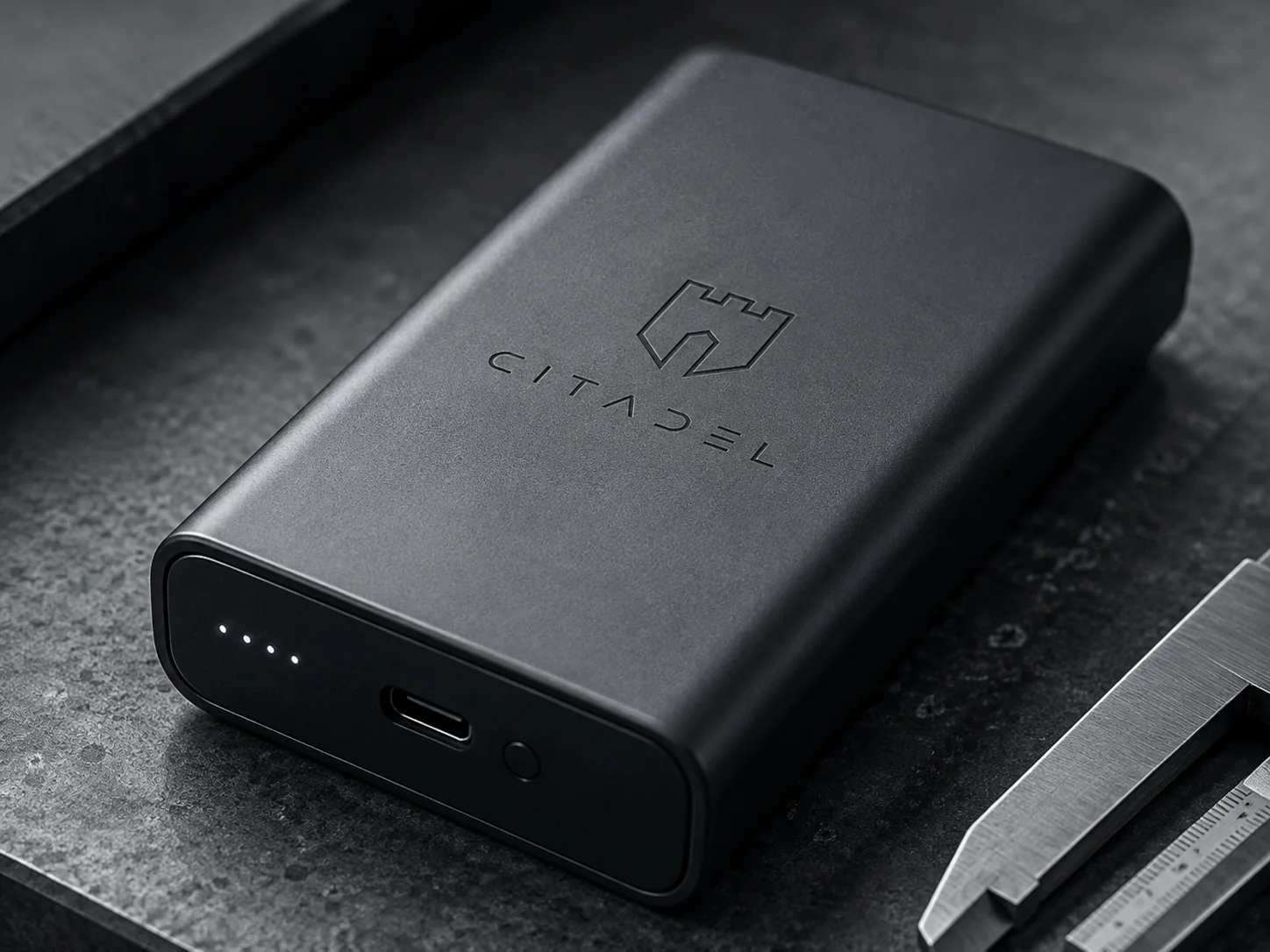
A product does not become CITADEL because a logo is placed on it.
It must earn its place.
Before release, product candidates are evaluated against the requirements of their category, the credibility of their specifications, the quality of the supplier and the risks carried by the customer.
Branding comes after admission — not before it.
Four stages. One standard.
A product moves forward through selection, testing, measurement and verification.
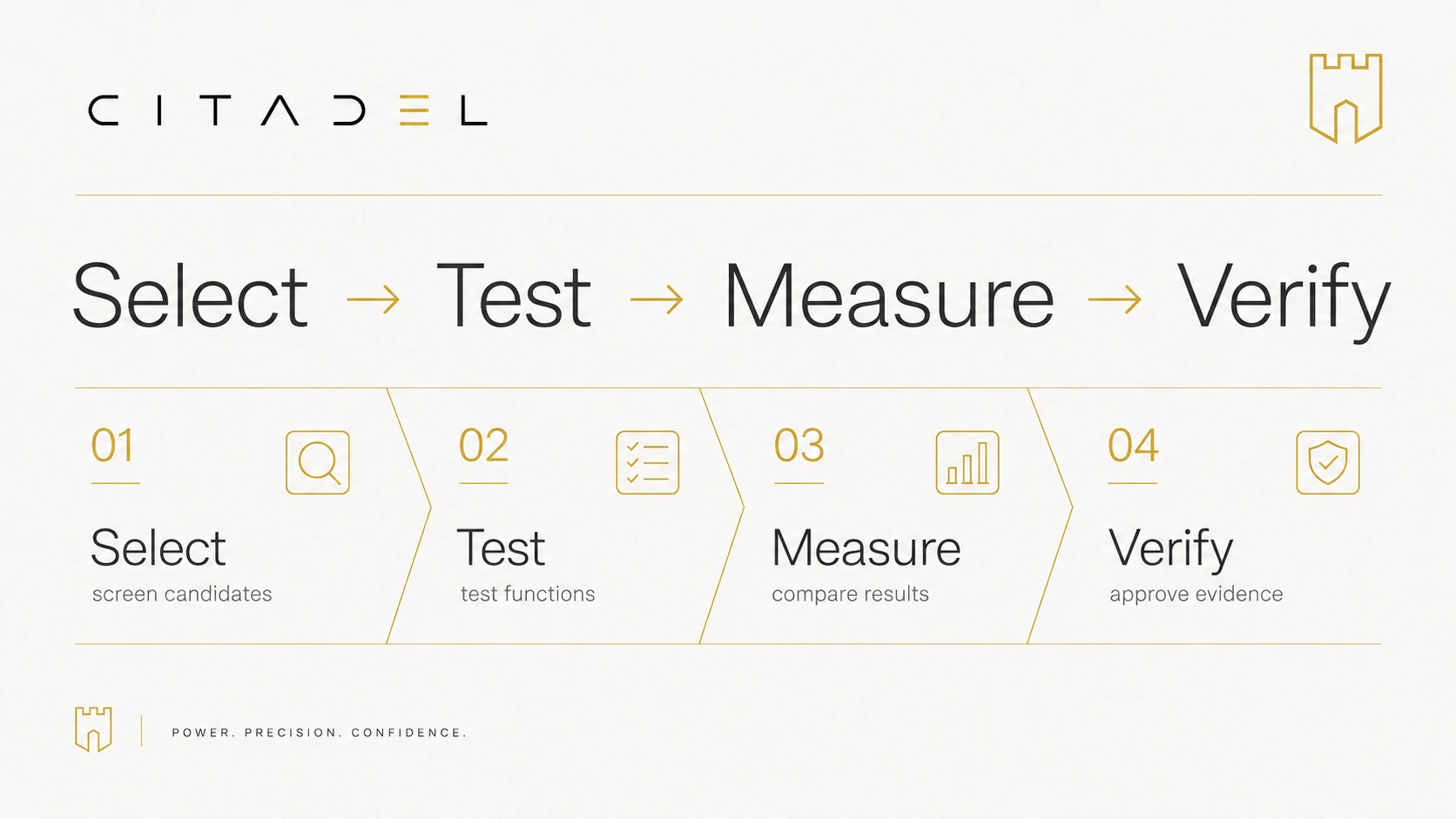
Select
Product candidates and suppliers are screened before admission. The objective is not simply to find something that can be sold, but to determine whether it deserves further evaluation.
Test
Functions and performance claims that matter for the product category are tested under defined conditions. What is tested depends on what the product claims to do.
Measure
Results are measured and compared against the stated specifications. Measurement turns a claim into something that can be examined, recorded and questioned.
Verify
Evidence is reviewed before a product moves forward. A claim is treated as verified only when the available evidence is sufficient to support it.
Different products.
Different tests.
Same rule.
A power bank should not be evaluated with the same checklist as a cable, charger, storage device or audio product.
Performance
Capacity, input and output power, charging behaviour, efficiency and other category-specific performance parameters.
Safety & Protection
Thermal behaviour, protection mechanisms, electrical safeguards and relevant safety characteristics.
Build & Reliability
Materials, connectors, assembly, mechanical interfaces and reliability factors relevant to the product.
Compatibility & Function
Protocols, connected devices, ports, operating modes and the functions the product claims to support.
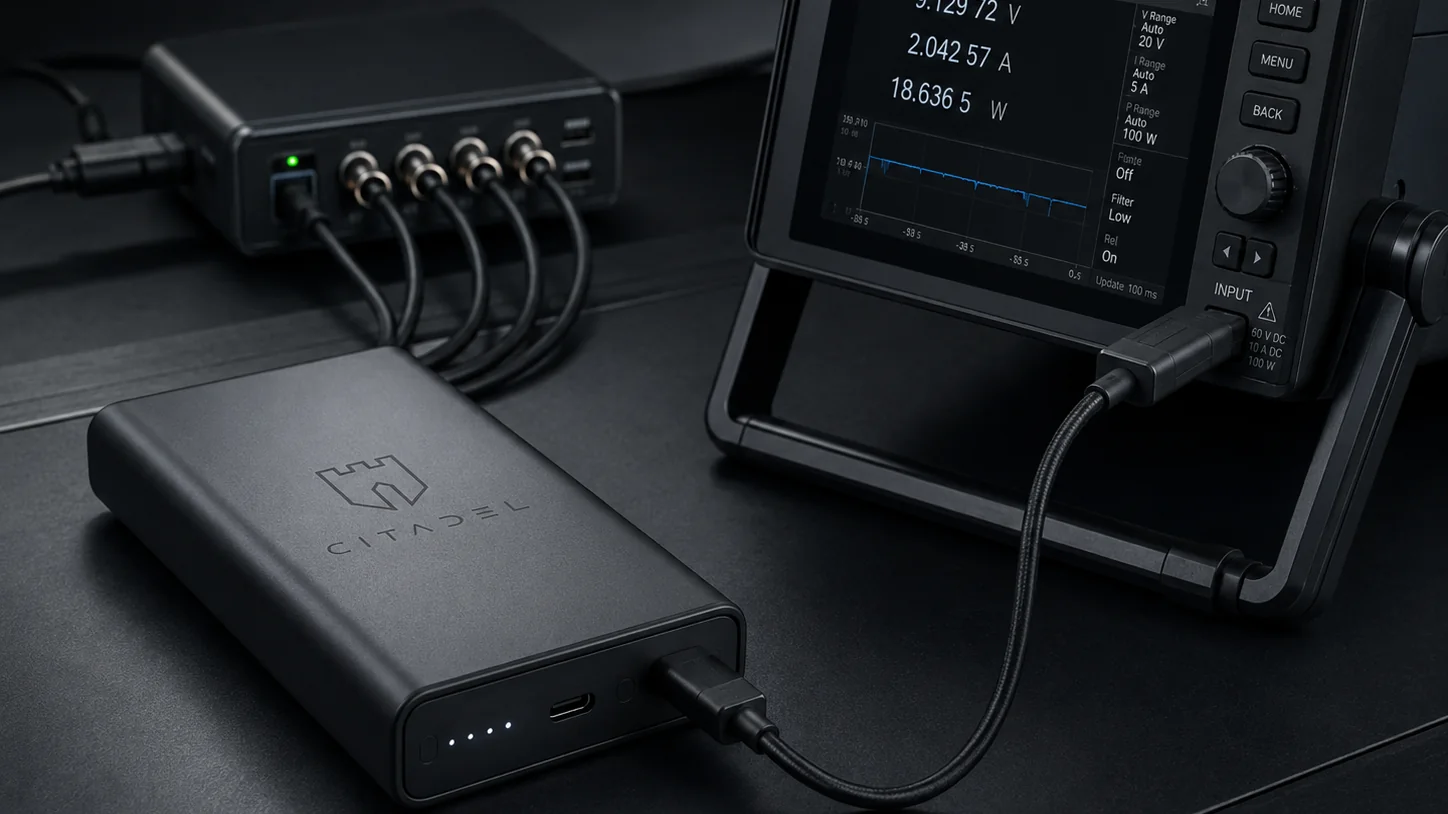
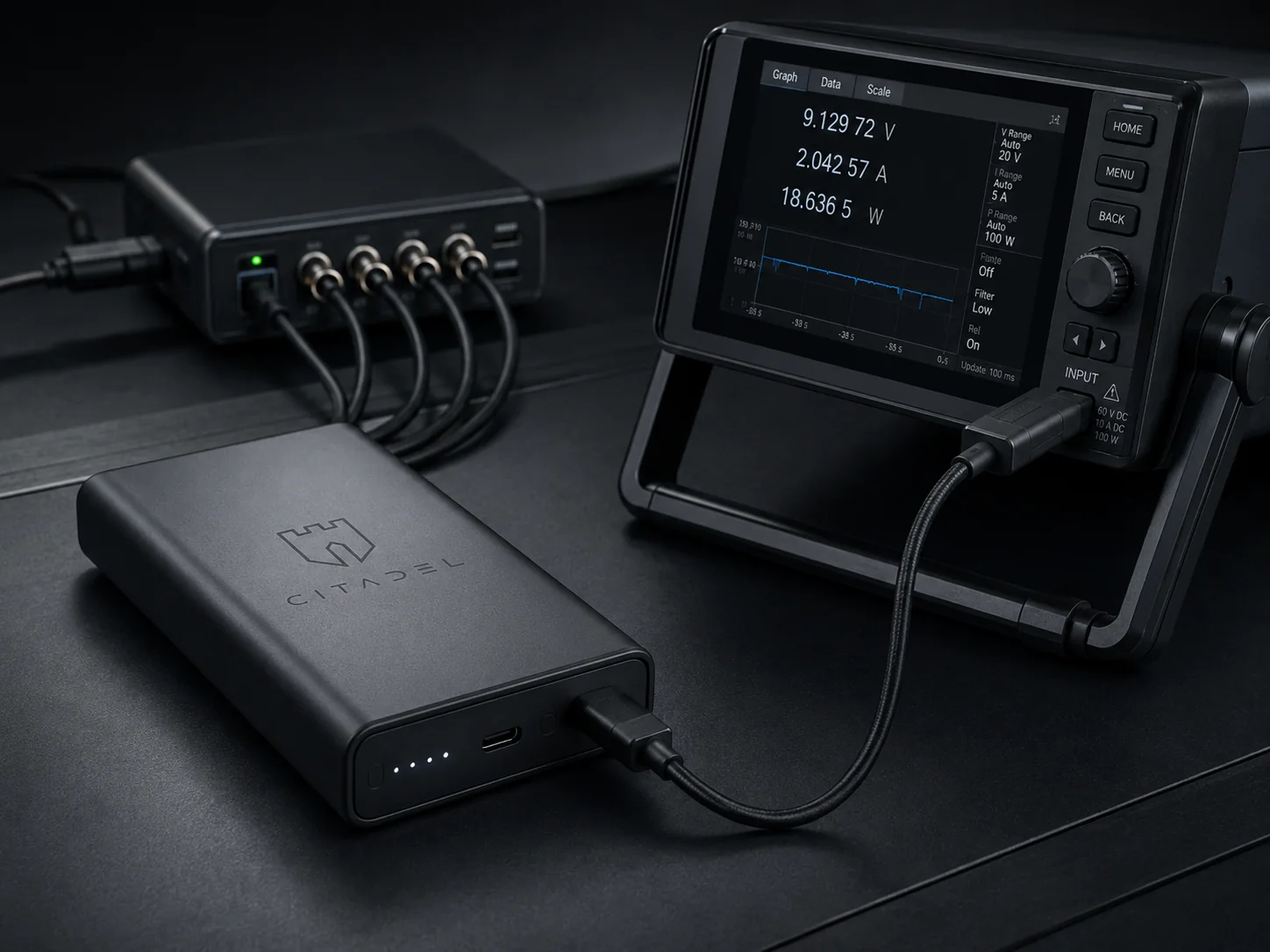
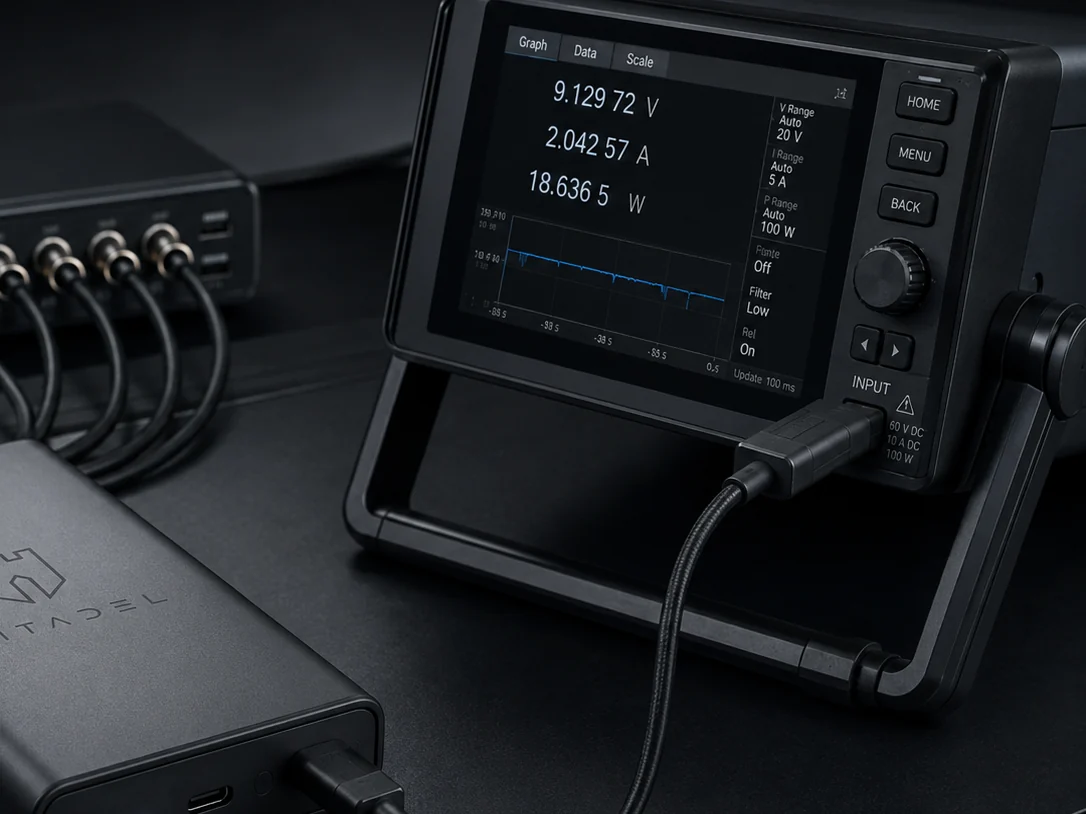
Measurement requires instruments, not adjectives.
Reliable evaluation of power products depends on more than observation.
It requires professional test equipment, defined electrical conditions, repeatable procedures and results that can be recorded and compared.
CITADEL is building its measurement infrastructure around this principle — creating a more disciplined way to understand what power products actually deliver.
The same philosophy is also being extended into professional power-testing systems offered under the CITADEL name.
Evidence before adjectives.
Fast. Powerful. Premium. Reliable. Words are easy. Evidence is harder.
Source Identified
The origin of important technical information should be identifiable — whether it comes from measurement, supplier documentation, certification or third-party evidence.
Conditions Matter
A number without its relevant test conditions can be misleading. Conditions are part of the result.
Claim ≠ Assumption
Something that has not been established should not be presented as verified.
Contradictions Are Resolved
When measured behaviour conflicts with a stated specification, the contradiction should be understood before release.
Verification should belong to a product.
Evidence becomes more useful when it can be connected to the product it describes.
CITADEL’s Product Identity architecture is designed to connect product model, batch and serial identity with authenticity, warranty and service history over time.
The goal is not simply to identify a product. It is to preserve the connection between the product and the promises made about it.

Passing a test is not the same as earning release.
A single successful measurement does not define a CITADEL product.
Release is a decision based on the combined picture: evidence, specification integrity, product quality, identity and customer risk.

The standard does not end at checkout.
What happens after a product reaches the customer matters.
Warranty claims, returns and field failures are not only service events. They are evidence about how a product performs outside controlled evaluation.
That information should flow back into product review, supplier decisions and future improvement.

Verification without exaggeration.
The CITADEL Standard means…
- Evidence-based product evaluation.
- Internal measurements identified as internal measurements.
- Results interpreted with their relevant conditions.
- Third-party tests and certifications identified when applicable.
- Test requirements adapted to the product category.
It does not mean…
- A guarantee that a product can never fail.
- Presenting internal testing as independent certification.
- Treating one result as universal under every device or environment.
- Blurring the difference between internal, external and certified evidence.
- Applying one generic checklist to every kind of product.
Exactly As Stated.
A simple promise, backed by a system designed to make that promise measurable.